Category: Multimedia Learning

Learning Through Storytelling

In Rich McCue’s example of storytelling, what senses does he appeal to in his story? Which of the guidelines does he follow? Are there any that he doesn’t follow?

In Rich McCue’s story telling with video example, he evokes emotion in order to  get the point across about backing up digital files. He does this by using various story telling techniques. He immerses the listener in the story by using strategically chosen images that relate to the part of the story he is telling and by painting a detailed picture of the scenario using descriptive words and explaining feelings. The story he tells is also a personal one, adding to the captivating nature of the story. He builds suspense by telling the story in chronological order, leading up to the tragedy that destroyed his students laptop. He does this by explaining how a brand new laptop looks and feels and by providing details of his conversation with his student, rather than revealing the tragedy right away. He uses dialogue in his story which allows the listeners to have a clear picture in their head of the scene, in doing this he employs the “show, don’t tell” technique. In this specific story I think it would be difficult for him to use the technique of “bringing the characters to life” as it is a personal story involving only him and his student. As well it does not appear that he uses the “S.T.A.R moment” technique but this could be due to the short nature of the story. He does end with a positive takeaway by explaining what you can do to protect yourself against losing your data and lets the audience know that his student follows these back up suggestions and now has peace of mind.

Rich also reduces cognitive load in his video by ensuring that the video is short and to the point (segmenting), he provides narration with complimentary pictures (matching modality), and he does not have any distracting music or extra animations (weeding).

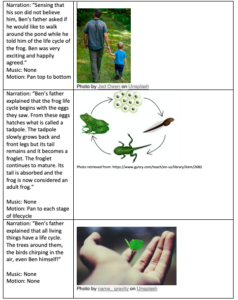
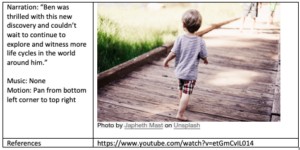
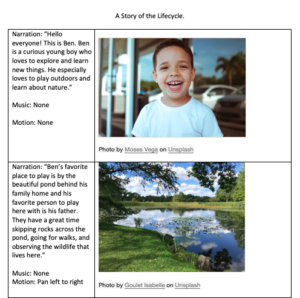
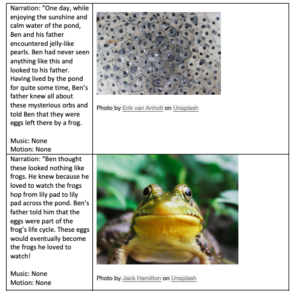
My Storyboard

At first, I found creating a story board difficult as I had trouble determining what it was that I wanted to teach through a story. I decided to create my storyboard this week in the same theme of my lesson plan and create a story involving life cycles. However, I made the learning outcome for this story  simpler in order to fit into a short story context and I wanted my story to have a children’s book feel to it. If this storyboard were to be used for learning material, it would likely be a different age/learning ability than my lesson plan was created for in my last blog.
Creating an Infographic

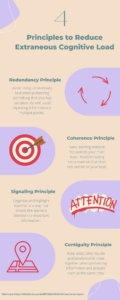
This week I choose to create an infographic using the design platform Canva. I decided to create an infographic on the 4 principles to reduce extraneous cognitive load mainly to use as a reference for myself while working through the rest of the course.

Alt Text: An infographic displaying the 4 principles used to reduce extraneous cognitive load: The redundancy principle, the coherence principle, the signaling principle, and the contiguity principle.

Creating My Infographic

I made sure to incorporate a few key design principles when creating my infographic:

Hierarchy: I made the title of the infographic the largest text font and put it at the top. This helps direct the readers attention to the top of the infographic and signals that the information begins there and continues down the page.

Contrast: I utilized contrast by the text and the pictures having their own designated sections on the infographic, as well the pictures are in a colour that “pops” from the rest of the infographic to help facilitate the association between the information and the pictures.

Colour: I used saturated but complimentary colours to create my infographic, however, I made sure to stick to a small colour palette to maintain cohesiveness and so as not to overwhelm the reader.

Proximity: I ensured that text was beside the associated picture so the reader does not have to guess which picture goes with which description and to give a natural flow to the infographic.

Negative Space: I left lots of negative space in my infographic to allow the reader a break between information and to enhance cohesiveness as explained in the youtube video “White Space in Infographic Designs: Why It Matters“. I made sure not to include too many details and just included the relevant definitions of the principles as introduces by the topic of the infographic.

Design Principles and Mayer’s Principle of Multimedia Learning

It is interesting how many of the key design principles align with the principles for reducing extraneous cognitive load in Mayer’s Principle of Multimedia Learning. The proximity design principle is very similar to the contiguity principle and the hierarchy principle is similar to the signaling principle. Clearly these principles are analogous for a reason and reinforces the concepts and ideas of how we process and learn information.

Final Thoughts About Canva

This was my first time using a design software such as Canva and I thoroughly enjoyed it and found it very fun to create! I found the software to be easy to use and I enjoyed how it constantly suggests creative design choices. I will definitely continue to use Canva in the future in my professional and personal life.

Exploring Sketchnoting

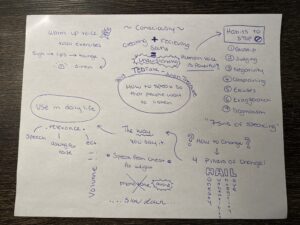
Alt Text: Photograph of a completed “sketchnote” created from a TEDtalk on effective communication

Reflecting on the Experience

This week, I attempted Sketchnoting while listening to a TEDtalk by Julian Treasure on the topic of effective communication. Although this is a video, I listened to the audio only to focus on my sketchnoting and creating my own visual experience. This was my first experience taking notes from learning material in this way and at first it did not feel natural to me. While listening to the talk, I found that I was worried about not transcribing all the information presented and missing important points. However, when I was finished I found that I could follow my sketchnote and remember the lecture. After completing this activity, I do see value in combining images with notes to aid in retention of material as discussed by Rachel Smith. I am curious to see if this absorption of the material is held over time and will come back to my sketch note at a later date to test this.

Creating the Sketchnote

Prior to listening to the TEDtalk and producing my sketchnote. I viewed the instructional video by Doug Neil on sketchnoting. Personally, I am not experienced in drawing so Doug’s video aimed at sketchnoting “without drawing” was very helpful for me. I utilized his techniques of conveying importance through text size and style and using containers and arrows to connect and segment ideas.

What Principles are at work?

When viewing my sketchnote as something that myself as a learner will use to recall information later there are a few principles from Mayer’s  theory of multimedia learning that I believe are at work here. The first if the Coherence Principle. When creating my sketchnote, I was mindful to only include and emphasize information that  would be helpful to my learning and retention. I avoided “decorating” the sketchnote and drew only visuals that related to the ideas presented. The Signalling Principle can also be applied. I used headers when possible and went into further detail underneath them to allow for a sense of organization and to direct my attention to important information and main points.

My Learning Material

Below is the TEDtalk video I created my sketchnote from. It is a great talk that anyone can related to as it can be applied when having conversations with others in daily life as well as in important and professional situations. It also relates to the concept of teaching when using your voice as narration is utilized.


Screencasting As A Teaching Tool

Navigating Instagram

Screencastify is an example of a tool that can be used for online multimedia learning. This week, I used Screencastify to create a screencast showing how to post a picture to the popular social media platform, Instagram. Instagram can be used for personal use to share pictures and videos with family and friends. It can also be used as a powerful marketing tool for businesses, providing a direct way to engage with customers and clients.

Providing Effective Instruction

When creating my screencast, I had to make choices about how to lead this instructional video in a way that enhances the learning of the viewer. I consulted Mayer’s Theory of Multimedia Learning, which assumes that learners take in information through two separate channels, the first being a visual channel and the second being an auditory channel. This assumption means that Screencastify is an effective teaching tool that utilizes both visual and auditory presentation. It is also important to consult Cognitive Load Theory, which focuses on minimizing effort wasted on distractions (extraneous load), managing working memory capacity (intrinsic load), and optimizing what the learner understands (germane load).

In order to minimize extraneous load, I had to be cognizant of how I was presenting the material. I considered the Coherence Principle from Multimedia Learning Theory and did not include any unnecessary information or details and abstained from including any background music. I also considered the Redundancy Principle and focused the presentation on visuals and spoken narration and minimizing text on screen (Davis & Norman, 2016).

References

Davis, G., & Norman, M. (2016). Principles of Multimedia Learning. Wiley University Services. https://ctl.wiley.com/principles-of-multimedia-learning/

Introduction

Photo by National Cancer Institute on Unsplash

I am taking the course EDCI337 to become more experienced in creating and connecting online. I appreciate the value of online learning and the ability to apply these skills in a variety of fields, especially in the current age of technology where online meeting spaces are becoming integrated in many aspects of our lives. Online learning is often discussed in the context of academics and employment, however, I am particularly interested in the field of healthcare and how multimedia platforms can be used to enhance healthcare delivery and patient experience.

As shown in this video, telehealth can be a great tool to provide patients with care, especially during the COVID-19 pandemic. With the increasing popularity of telehealth, it is interesting to consider if this type of digital engagement could be utilized in other medical settings as well, such as rehabilitative medicine or mental health. While not all aspects of care can be delivered online and many in-person aspects cannot be replaced, it may reduce barriers and provide care to a wider reach in our communities. Through this course, I hope to learn more about how people connect and interact digitally and how to enhance one’s experience online.

© 2026 Darby's Blog

Theme by Anders NorenUp ↑