Creating the Lesson Plan
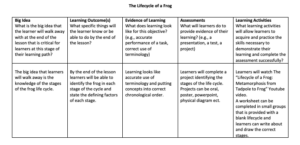
This week I created a lesson plan teaching the lifecycle of a frog. I created this lesson based on backwards design and started with the goal of learning the life cycle of a frog, I then began to work backwards by creating an associated learning assessment and creating learning outcomes and evidences of learning to meet that goal and prepare learners for the learning assessment.
Merrill’s First Principles of Instruction
When creating this lesson, I consulted Merrill’s First Principles of Instruction. There are five principles that Merrill deems essential for effective learning. The five principles are as follows:
- Learning is promoted when learning are engaged in solving real-world problems.
The concept of the frog life cycle is valuable to understanding the concept of metamorphosis in other species and lays the foundation for future biological study regarding growth and reproduction. Science helps to understand real-world phenomenons. Progression of complexity can also be applied here by first introducing the stages of the life cycle and then breaking it down into the defining characteristics.
- Learning is promoted when existing knowledge [and skill] is activated as a foundation for new knowledge [and skill].
This principle refers to activating prior knowledge or providing foundational experience. If learners had experience with the general concept of a biological life cycle (ie cyclical stages that form a repeating cycle) then this could be prior knowledge that could be activated.
- Learning is promoted when the instruction demonstrates what is to be learned.
Demonstrating what is to be learned can be done in the way of the media video narrating the life cycle of a frog and showing relevant video demonstrating what is being narrated. This provides audio and visual demonstration of what is being learned. The chosen video will need to demonstrate all concepts required in the learning assessment.
- Learning is promoted when learners are required to use their new skills to solve problems.
Applying the new learning is done in the way of completing worksheets in small groups. This way, learners can practice organizing the life cycle in chronological order and practice discussing the concepts with peers, solidifying the learning that has occurred. The worksheet can also include a drawing section allowing learners to demonstrate the concepts with visuals that are meaningful to them.
- Learning is promoted when learners are encouraged to integrate the new knowledge or skill into their everyday life.
This principle refers to demonstrating, integrating, and creating using the newly learned information. This principle can be incorporated by having the learning assessment be in the form of a project. The learner can choose the medium for the project, giving them control over their learning and allowing them to demonstrate what they have learned while assisting learning at the same time by getting the learner engaged with the material.
Learning Material
After designing the lesson plan, I looked for media that would clearly demonstrate all the concepts necessary to achieve the learning goals and assist learners in completing the learning assessments and activities. This video provides audio and visual information about the stages of the frogs life cycle and the associated physical changes. I could take this further by creating my own media perhaps in the form of an infographic to show these concepts and reinforce the learning outcomes.
A Note on Accessibility
In one of my previous blog posts “Enhancing Accessibility“, the WAVE accessibility software found that the teal hyperlink text colour had too low of contrast, however, I could not determine how to change it and believed it to be embedded in the template. This week, I have figure out how to change it! I ran this post through the WAVE software and did not get a low contrast notice for the green colour I have chosen for the hyperlinks.
Wow Darby, great post this week! I appreciate how thorough and thoughtful your lesson design was – right down to providing effective media that applies dual coding theory to assist in students learning and retention. One critique I have would be to switch your Big Idea from: “Learners will walk away with knowledge of the stages of the frogs lifecycle” to “Learners will understand that living things have cycles adapted to their environment.” This would broaden the focus from one specific animal to eventually applying it to many different lifecycles (animals, plants etc.).